OSHA Safety Data Sheets For Dental Offices: SDS Guide
Build a compliant dental SDS system with DDS Rescue. Expert help with OSHA requirements, chemical inventory, storage & maintenance. Stay audit-ready.
Key SDS Actions For Dental Offices
- OSHA requires a Safety Data Sheet for every hazardous chemical in the office, with sheets accessible on every shift and a written inventory that links each product to its SDS.
- A typical four-operatory practice needs 30 to 60 SDSs covering disinfectants, sterilants, etchants, bonding agents, composites, impression materials, X-ray chemicals, amalgam, nitrous oxide, and more.
- Build the chemical inventory room by room through sterilization, operatories, X-ray, lab, and front office, recording manufacturer, product name, and storage location.
- Most offices do better with an electronic SDS system because it updates quickly and is searchable, supported by a documented backup plan for outages.
- DDS Rescue provides mock audit walkthroughs, written deficiency reports, and a live client portal that flags stale documentation before an inspector does.
Talk With A Dental Compliance Specialist
What OSHA Actually Requires For SDSs In A Dental Office
Under 29 CFR 1910.1200, employers must maintain a Safety Data Sheet for every hazardous chemical in the workplace. Those sheets must be readily accessible to employees on every work shift in their work areas. A written chemical inventory ties each product to its SDS so staff can find the right sheet quickly. Containers must be labeled, and employees must be trained at initial assignment and whenever a new chemical hazard is introduced.
Every SDS follows the standardized 16-section format in Appendix D to 29 CFR 1910.1200. Sections 1 through 11 and Section 16 are mandatory and enforced by OSHA. Sections 12 through 15 must appear in the document, but OSHA does not enforce them under HazCom. Those four sections cover ecological information, disposal, transport, and regulatory information.
For the full regulatory picture, including bloodborne pathogens, the written HazCom program, labeling, and training, see DDS Rescue’s OSHA HazCom Compliance For Dental Offices. This article focuses on building and maintaining the SDS system itself.
Which Dental Office Products Need An SDS
Knowing the regulation is only half the job. The harder task is deciding which products in your office actually need a sheet. A dental office is a chemically dense workplace, and the list of products requiring SDSs is longer than most office managers expect. A typical four-operatory dental practice has between 30 and 60 distinct chemical products requiring SDSs.
The following product categories in a dental office typically require an SDS:
- Surface disinfectant wipes and sprays (quaternary ammonium products, sodium hypochlorite, alcohol-based products)
- Enzymatic cleaners and ultrasonic cleaning solutions
- Sterilants and high-level disinfectants (glutaraldehyde, ortho-phthalaldehyde, hydrogen peroxide, peracetic acid)
- Phosphoric acid etchants (typically 30–40% concentration)
- Bonding agents and composites (methacrylate-based products including HEMA, Bis-GMA, TEGDMA)
- Impression materials (polyvinyl siloxane, polyether, alginate)
- X-ray processing chemicals (developer and fixer)
- Amalgam capsules (dental amalgam is approximately 50% mercury by weight)
- Nitrous oxide cylinders
- Handpiece lubricants (petroleum distillates)
- Autoclave cleaners and biological indicators
- Waterline treatment chemicals
The practical rule comes from OSHA practice: if the manufacturer was required to produce an SDS for the product, treat it as covered. Consumer-style products used with the same manner, duration, and frequency as a household consumer may qualify for an exemption under 29 CFR 1910.1200(b)(6)(ix). That exemption is narrow, and a disinfectant used repeatedly throughout a clinical workday does not qualify. When the exemption is uncertain, OSHA compliance practice is to retain the SDS and train on it, because an extra sheet in an organized library costs almost nothing while guessing wrong surfaces during an inspection.
How To Build A Dental Chemical Inventory That Works
The chemical inventory makes the SDS system maintainable. It defines which products should have SDSs and where they live in the office. Without it, you guess and hope nothing is missing.
Build the inventory by walking the office room by room. Every area where staff work with or around chemicals is a work area under OSHA. Move through each zone and log every product:
- Sterilization area: sterilants, enzymatic cleaners, autoclave cleaners, biological indicators, waterline treatment products
- Operatories: surface disinfectants, etchants, bonding agents, composites, impression materials, handpiece lubricants, nitrous oxide
- X-ray area: developer, fixer
- Lab: impression materials, acrylic monomers, polishing compounds
- Front office and storage: general cleaning products, hand hygiene products
For each product, record the manufacturer name, exact product name, and storage location. The arrangement that works uses one accountable person at each location who also touches purchasing, so buying a chemical and recording it become the same event.
DDS Rescue’s mock audit walkthrough reviews the sterilization area, instrument processing, and waterlines on camera. The written deficiency report that follows lists what is missing from the chemical inventory, so you receive a finite set of corrections based on your actual facility.
How To Get SDSs You Do Not Have
Under 29 CFR 1910.1200(g)(6)(iii), if an SDS is not provided with a shipment labeled as a hazardous chemical, the distributor or employer must obtain one from the chemical manufacturer or importer as soon as possible.
Start with the manufacturer’s website. Henry Schein maintains an online SDS library accessible through product detail pages, the Chemical Inventory Report, and the online SDS Look-Up Tool, and Patterson Dental maintains the AutoSDS online Safety Data Sheet Portal, preloaded with SDSs from Patterson Dental purchases over the previous 5 years. Search by product name or SKU. If the product came through a distributor, log into the distributor portal and search there. If a sheet is missing, the person responsible for SDS records should contact the manufacturer or supplier and request a copy.
If a manufacturer will not provide an SDS, document the request in writing and keep that documentation. If a supplier refuses to provide an SDS, employers should contact the manufacturer directly in writing and avoid using the product until an SDS is obtained. If the manufacturer remains unresponsive, evaluate whether the product belongs in the office at all.
Where SDS Sheets Belong In A Dental Office
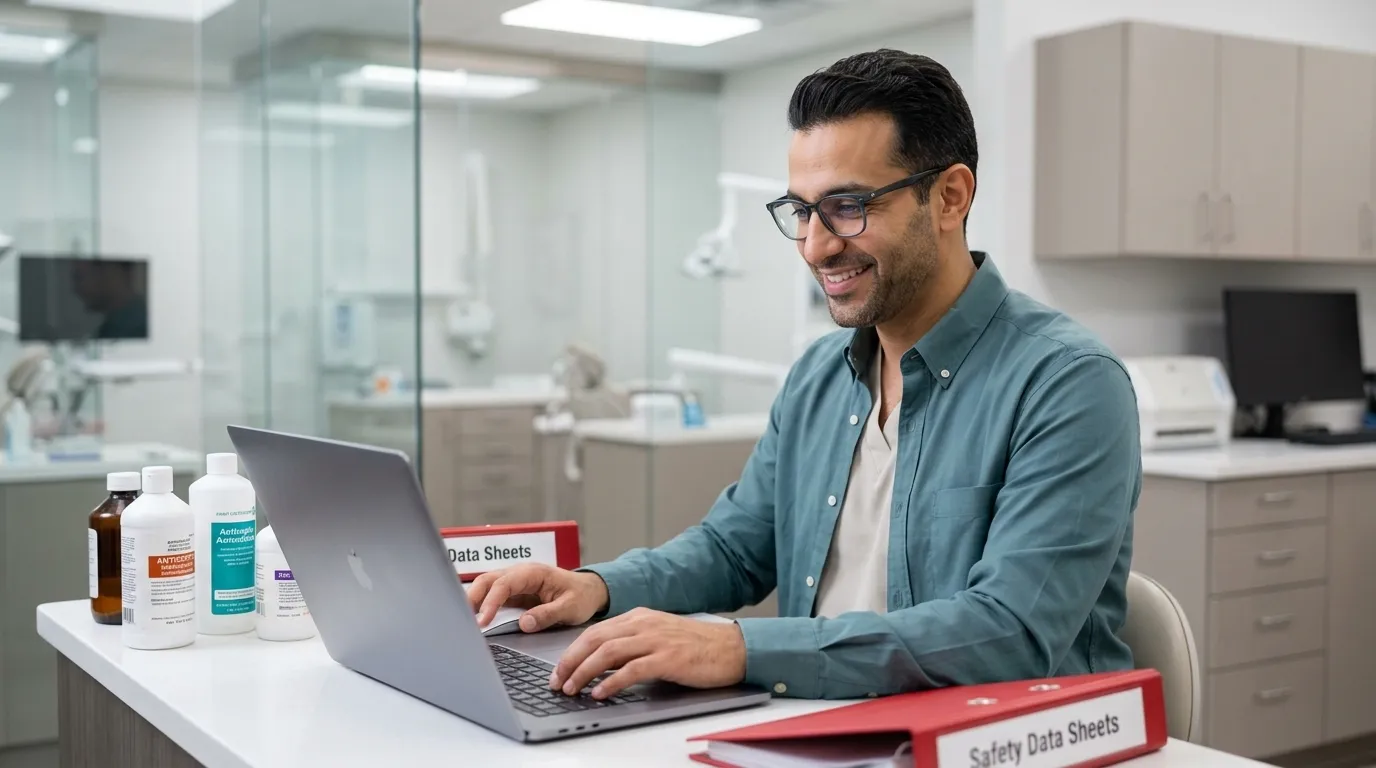
SDSs must be readily accessible to employees during every work shift in their work areas. Access can be through a physical binder kept where staff can reach it without asking permission or through an electronic system employees can open immediately without barriers.
Under 29 CFR 1910.1200(g)(8), electronic access is acceptable as long as employees can reach it without barriers. A supervisor login, a device locked in a manager’s office, or a system that goes dark when the network fails all count as barriers. Electronic systems should have a reliable backup procedure for power, network, device, or system failures.
The table below compares the two primary access methods and shows why electronic systems usually win on currency and searchability, while paper wins on outage resilience:
| Attribute | Paper Binder | Electronic System |
|---|---|---|
| Update Speed | Manual, goes stale when no one updates after a product change | Instant when maintained, propagates updates across all locations simultaneously |
| Searchability | Alphabetical only | Full-text search |
| Every-shift Access | Requires physical presence at binder location | Requires device and network, backup plan required for outages |
| Backup Requirement | None needed | Documented plan required, printed backup or cached copy satisfies requirement |
| Best For | Small offices with few products, never crashes, needs no login | Most dental offices, easier to keep current and searchable |
Electronic access works best as the primary system for most dental offices. A printed backup for the products most likely to be needed in an emergency, such as sterilants, high-level disinfectants, and nitrous oxide, gives staff immediate access if the network is unavailable.
How To Keep Your Dental Office SDS System Current
Compliance depends on keeping SDSs current, not just having a stack of documents. Offices fall behind when products change, but the inventory and sheets stay frozen.
An SDS does not expire, but it becomes non-compliant the moment it stops describing the chemical actually present at the facility. Three situations require immediate action:
- A product is discontinued: Remove it from the active inventory. Archive the SDS rather than deleting it, because 29 CFR 1910.1020 requires records of hazardous substance exposures to be retained for 30 years.
- A new product arrives without an SDS: Keep it off the shelf and out of use until the SDS is obtained. Request it in writing from the manufacturer or distributor and document the request.
- A manufacturer changes a formulation: Replace the active SDS with the current version. If an SDS is more than three to five years old, check the manufacturer’s website for a newer version.
A practical maintenance routine starts with a quarterly inventory review, but the review only holds if one person owns additions and removals. Connect that person to purchasing so buying a new chemical and recording it happen together. An inventory that was accurate in March and wrong in June does not become compliant because a review is scheduled for December.
DDS Rescue’s client portal functions as a live database that flags a practice whose documentation has gone stale. DDS Rescue contacts the practice before an inspector does, so the office manager does not have to remember every deadline alone.
See What An Inspector Would Flag
What An Inspector Actually Asks For
Inspectors focus on what your team can prove and demonstrate. An OSHA inspector will ask to see the written hazard communication program and the chemical inventory. They will ask to see an SDS for a specific product, often one they spotted in the operatory or sterilization area. They will ask an employee, not the office manager, where the SDSs are kept and how to find one. If workers cannot locate and use the SDS, the training record on file carries little weight.
OSHA complaints can originate from a current or former employee, which makes the timing of an inspection unpredictable. That reality supports year-round preparedness instead of a last-minute scramble. Inspectors judge what the office can prove on paper, so records weigh as much as habits. A spotless operatory with no sterilizer log still fails an inspection.
Edge Cases And SDS Exemptions For Dental Offices
Several exemptions exist under 29 CFR 1910.1200, and many are narrower than offices assume.
Products that are genuinely exempt from SDS requirements include:
- Consumer products used in the same manner, duration, and frequency as a household consumer, and the exemption fails if either condition is not met
- FDA-regulated drugs in solid, final form for direct administration to a patient, such as tablets and capsules
- Articles that release no hazardous chemicals under normal use
- Hazardous waste regulated under RCRA
Products that offices sometimes treat as exempt but that still require SDSs include:
- Sterilants, disinfectants, etchants, bonding agents, composites, impression materials, and X-ray chemistry, and the drug exemption does not cover these
- Nitrous oxide cylinders
- Amalgam capsules
- Hand hygiene products used at clinical frequency throughout the day
On enforcement scope, OSHA does not enforce Sections 12 through 15 of the SDS under HazCom. Those sections must appear in the document, but OSHA’s enforcement authority under 29 CFR 1910.1200 covers Sections 1 through 11 and Section 16.
Frequently Asked Questions About Dental SDS Compliance
Which Products In A Dental Office Need An SDS?
Most clinical chemicals in a dental office require SDSs. See Which Dental Office Products Need An SDS above for the full list and examples.
What Is Exempt From SDS Requirements?
Only a narrow set of consumer products, certain solid-form drugs, true articles, and hazardous waste qualify. See Edge Cases And SDS Exemptions For Dental Offices for details.
Where Should SDS Sheets Be Kept In A Dental Office?
SDSs must be accessible to employees in their work areas on every shift, either in a reachable binder or an electronic system with a documented backup. See Where SDS Sheets Belong In A Dental Office for placement and system options.
How Often Should SDSs Be Updated?
Update SDSs whenever products change or manufacturers issue new versions. A quarterly inventory review with spot checks against manufacturer sites keeps the library current. See How To Keep Your Dental Office SDS System Current for a step-by-step routine.
What If A Product Arrives Without An SDS?
Request the SDS from the manufacturer or distributor and hold the product out of use until you receive it. See How To Get SDSs You Do Not Have for sources and documentation tips.
Does OSHA Require SDS Training?
Yes. Under 29 CFR 1910.1200(h), employees must be trained at initial assignment and when new chemical hazards appear. Training must cover how to read and access SDSs and how to use protective measures.
Can DDS Rescue Help Us Build Our SDS System?
DDS Rescue helps practices build and maintain SDS systems through a mock audit walkthrough, a written deficiency report, and a live portal that flags stale documentation. More than 1,000 practices work with DDS Rescue nationwide, with an 85% renewal rate on compliance clients.
Get Help Building Your SDS System
Turn SDS Management Into A Maintained System
Most office managers carry compliance on top of a full-time job and receive little guidance on SDS systems. They understand the regulation in theory but still need clear direction on which products need sheets, how to build the inventory, how to handle unresponsive manufacturers, and what inspectors actually check.
A reliable SDS program functions as a maintained system, not a one-time project. That system uses a live inventory, a process for new and discontinued products, a documented access method with a backup, and a clearly assigned owner who keeps everything current.
DDS Rescue is a dental-exclusive compliance partner that turns SDS management from paperwork into a maintained system. The service combines a live mock audit walkthrough, a written deficiency report, and a portal that flags stale documentation before an inspector does. For more on OSHA compliance for dental offices, see Dental Office OSHA Certification: What It Is And Covers and OSHA Training For Dental Offices: How To Get Compliant.